



New Research: Why Menopausal Weight Gain Doesn’t Have to Be Inevitable



Key Takeaways
- 63% of women in perimenopause or menopause experience weight gain.1 But this menopausal weight gain doesn’t have to be inevitable.
- New research suggests that dietary interventions in midlife women, particularly those aimed at reducing carbohydrates, may significantly mitigate weight gain during menopause, regardless of estrogen use.4
- The menopause & metabolic connection: Hormonal changes during menopause can lead to weight gain and bone loss, while also raising the risk of heart disease, type 2 diabetes, and metabolic syndrome.
- Virta Health’s clinical nutrition approach–alongside, after, or without GLP-1s–can help address metabolic deterioration and related weight gain during menopause.
63% of women in perimenopause or menopause experience weight gain.1 Data show that women between the ages of 40 and 64 have been the top recipients of GLP-1 prescriptions since 2019,2 contributing to a 200% annual increase in GLP-1 costs reported by organizations in 2023 alone.3
But this menopausal weight gain doesn’t have to be inevitable.
As an endocrinologist, I specialize in hormones and the body’s endocrine system. Hormones play an important role in regulating metabolism and what happens in the body during menopause. Understanding these hormonal changes and how they affect metabolic health, combined with new research on proven dietary interventions, can help women reduce menopausal weight gain.
Let me explain how.
How the body’s metabolism slows down and causes weight gain during menopause
During the menopause transition, hormonal changes affect the body’s metabolism and how efficiently the body converts food into energy. Menopausal hormone changes can lead to fewer calories burned, more fat storage, and increased hunger. And it’s not just one hormone - menopause is caused by multiple hormonal changes, including estrogen, progesterone, cortisol, insulin, testosterone, and appetite hormones.5
Here are some of the ways menopausal hormonal changes affect metabolic health and ultimately lead to weight gain:
- Lower estrogen levels accelerate loss of lean muscle mass and slow the body’s resting metabolism, so the body burns fewer calories at rest.5
- In turn, lower estrogen shifts where the body stores fat, causing it to collect around the abdomen.5
- Hormonal changes, including increased cortisol, also make the body more prone to insulin resistance, resulting in increased fat storage and sugar cravings.5
- Progesterone changes can cause hot flashes and night sweats during menopause, which disrupt sleep.5 Lack of sleep can, in turn, raise the hunger hormone ghrelin while lowering the fullness hormone leptin, leading to cravings for high-calorie, carb-heavy foods.6
Why employers should not overlook women’s metabolic health during menopause
Overlooking metabolic health during menopause can lead to serious downstream health risks and costs for employers and employees alike. The extra fat that accumulates around the abdomen and internal organs during menopause can increase the risk of heart disease, type 2 diabetes, and metabolic syndrome,7 a group of conditions that increase the likelihood of serious cardiovascular and metabolic complications.8

Still, despite these risks, 51% of women in menopause or perimenopause have been told their weight gain at their age is ‘normal’ and not worth treating, according to a Virta survey.1
However, new research suggests that menopausal weight gain is not inevitable and can be treated through dietary intervention.
What is the best diet for menopause weight loss?
New research suggests that dietary interventions in midlife women, particularly those aimed at reducing carbohydrates, may significantly mitigate metabolic deterioration during menopause, regardless of estrogen hormonal therapy use.3
The study evaluated 1-year trajectories of Body Mass Index (BMI), weight, and HbA1c (blood sugar levels) among female patients aged 45 and older with type 2 diabetes. Patients remained in a digital nutrition program centered on carbohydrate reduction for more than 1 year. The team then determined whether estrogen therapy modified these patients’ outcomes.4
The 1-year study showed metabolic health and weight improvements during menopause:
- BMI decreased from 33.84 to 30.7.4
- HbA1c (blood sugar) decreased from 7.24% to 6.56%.4
- Weight decreased from 200.19 to 181.57 pounds.4
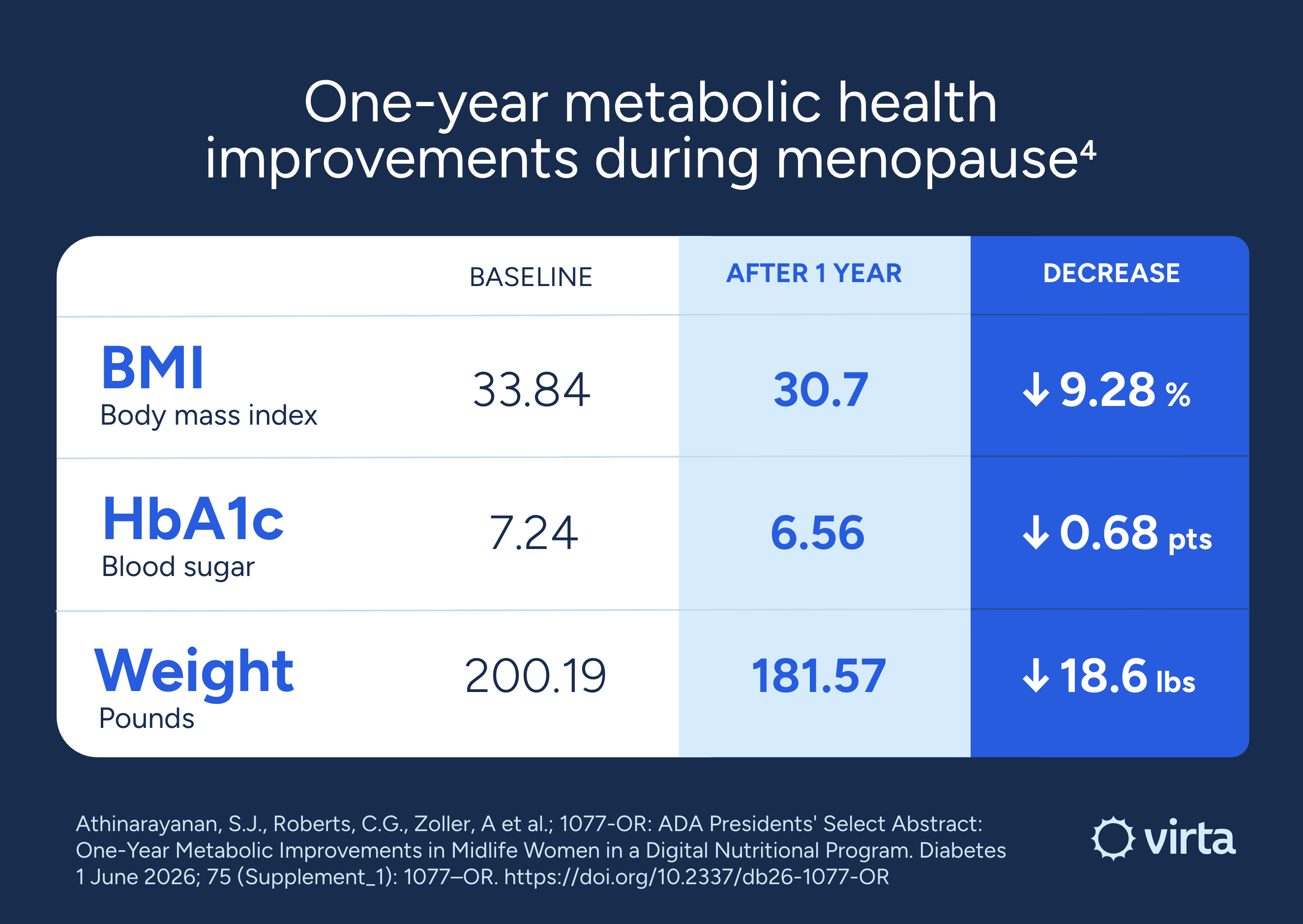
In fact, BMI and blood sugar levels (HbA1c) both shifted toward healthier, lower-risk classifications, indicating overall metabolic health improvement.
These findings suggest that dietary interventions can change the downward trajectory of metabolic health during menopause regardless of estrogen therapy use. In particular, the study highlights how carbohydrate reduction could potentially mitigate metabolic deterioration with or without estrogen.
How does limiting carbohydrates help reduce weight gain during menopause?
Limiting carbohydrates during menopause can help stabilize blood sugar and lower insulin levels, helping to restore metabolic health and reduce weight gain.
In particular, avoiding refined carbohydrates like white bread, pasta, and cookies can reduce blood sugar spikes and subsequent insulin surges, reducing the body’s tendency to store excess energy as fat. It also minimizes hunger cravings, making it easier to maintain a healthy weight.
Dietary interventions that limit refined carbohydrates during the menopausal transition may improve women’s health and change their disease trajectory. For example, midlife women with obesity can mitigate menopausal weight gain as well as their risk of progressing into type 2 diabetes.
Can GLP-1s help reduce menopause weight?
GLP-1s can help women reduce weight gain during menopause, but GLP-1s aren’t a standalone weight-loss strategy. Because these medications suppress appetite, personalized clinical nutrition, behavior change support, and medical oversight are critical to help women meet their nutritional needs, minimize muscle loss, manage menopause-related side effects, and sustain long-term weight loss and overall health benefits.
Read more about the role of nutrition during weight loss and GLP-1s.
How Virta Health can help women restore metabolic health and reduce weight gain during menopause
Recognizing that each woman’s menopause journey is unique, Virta Health can improve metabolic health and drive sustainable weight-loss outcomes through personalized clinical nutrition and behavioral coaching, with or without GLP-1s.
Virta for Weight Loss+ can deliver wraparound support to help women optimize weight-loss outcomes during menopause, alongside, after, or even without GLP-1s.
Key highlights include:
- Personalized clinical nutrition that improves metabolic health. Virta can help women lower their refined carbohydrate intake based on their unique metabolic response, while emphasizing protein and healthy fats. This approach reduces hunger cravings while improving metabolic function during menopause, creating the conditions for weight loss with or without GLP-1s.
- Behavior change guided by metabolic insight. Virta’s app, AI tools, ketone tracking, coaching, and care team create a feedback loop that guides decision-making and turns nutrition from guesswork into guided, personalized action. Behavior change coaching also helps women stick to their lifestyle and diet habits and sustain weight loss after GLP-1s or without GLP-1s.
- Safe prescribing and medication management. Virta Health works alongside the employer's preferred access and fulfillment strategy by integrating with PBMs and alternative funding solutions, such as Cash Pay direct-to-consumer models, to ensure safe, clinically monitored, and cost-effective GLP-1 prescriptions.
By partnering with Virta, employers can help women restore their metabolic health during menopause, reduce weight gain, lower health risks, and ultimately regain control of their lives.
Related resources
[Report] Menopause and metabolism: A wake-up call for women’s health
[Webinar replay] The menopause-metabolic connection
This blog is intended for informational purposes only and is not meant to be a substitute for professional medical advice, diagnosis, or treatment. Always seek the advice of your physician or other qualified health provider with any questions you may have regarding a medical condition or any advice relating to your health. View full disclaimer
Are you living with type 2 diabetes, prediabetes, or unwanted weight?

- Virta-commissioned survey, 500 US women ages 45+, currently experiencing perimenopause or menopause, July 2025
- Women Approaching Menopause Drive GLP-1 Boom, June 25, 2025, https://www.axios.com/2025/06/25/ozempic-weight-loss-women-menopause-glp1
- GLP-1s Now ‘Predominant Driver’ of Drug Spend Growth, SHRM, April 8, 2025, https://www.shrm.org/topics-tools/news/benefits-compensation/glp1-driving-historic-drug-spend-growth
- Athinarayanan, S.J., Roberts, C.G., Zoller, A et al.; 1077-OR: ADA Presidents' Select Abstract: One-Year Metabolic Improvements in Midlife Women in a Digital Nutritional Program. Diabetes 1 June 2026; 75 (Supplement_1): 1077–OR. https://doi.org/10.2337/db26-1077-OR
- Rajagopal, Selvi, MD, MPH, Menopause and Weight Gain, Johns Hopkins Medicine, https://www.hopkinsmedicine.org/health/expert-qa/menopause-and-weight-gain
- Molumphy, Nicole, How Sleep Deprivation Affects Your Metabolic Health, Stanford Lifestyle Medicine, Stanford University, Aug 2024,https://lifestylemedicine.stanford.edu/how-sleep-deprivation-affects-your-metabolic-health/
- Erdoğan K, Sanlier N. Metabolic Syndrome and Menopause: The Impact of Menopause Duration on Risk Factors and Components. Int J Womens Health. 2024;16:1249-1256, https://doi.org/10.2147/IJWH. S460645
- What is Metabolic Syndrome, NIH, https://www.nhlbi.nih.gov/health/metabolic-syndrome




.jpg)
.jpg)