
New Research: How Metabolic Care Lowers the Risk of Kidney Disease by 62%



Key Takeaways
- New peer-reviewed research suggests that individualized nutrition-based metabolic care may significantly reduce the risk of chronic and advanced kidney disease, major complications and comorbidities associated with obesity or type 2 diabetes—and conditions that drive substantial long-term healthcare costs for employers.
- In one of the largest real-world studies of nutrition-based metabolic care, tracking more than 22,000 individuals (10,000+ Virta members with follow-up extending up to 5 years and 10,000+ matched usual-care controls), the findings revealed that adults with type 2 diabetes or obesity participating in Virta's individualized treatment experienced substantially lower rates of chronic kidney disease (CKD), including a 62% lower rate of advanced kidney disease, when compared with carefully matched individuals receiving usual care.1
- For employers, the findings suggest that addressing metabolic health through individualized nutrition may play an important role in reducing the incidence of new CKD diagnoses and advanced CKD outcomes–underscoring an opportunity for employers to intervene earlier to change the trajectory and potentially avoid downstream healthcare costs in the future.
Chronic kidney disease (CKD) is a metabolic disease that is often symptomless until it’s too late–costing billions of dollars in healthcare costs. In 2022, Medicare spent $95.7 billion caring for beneficiaries with CKD, excluding kidney replacement therapy, while dialysis treatment cost an additional $45.3 billion.2 Not to mention the increased risks of heart disease, stroke, and premature death.
CKD was historically viewed as a common and often progressive consequence of diabetes and obesity. But new Virta research1 suggests that addressing metabolic health through individualized nutrition may play an important role in lowering the risk of chronic kidney disease progression–underscoring an opportunity for employers to intervene earlier to change the trajectory of the disease.
First, it’s important to understand how the body’s metabolic health and kidney disease are closely interrelated.
What is the connection between metabolic health and kidney disease?
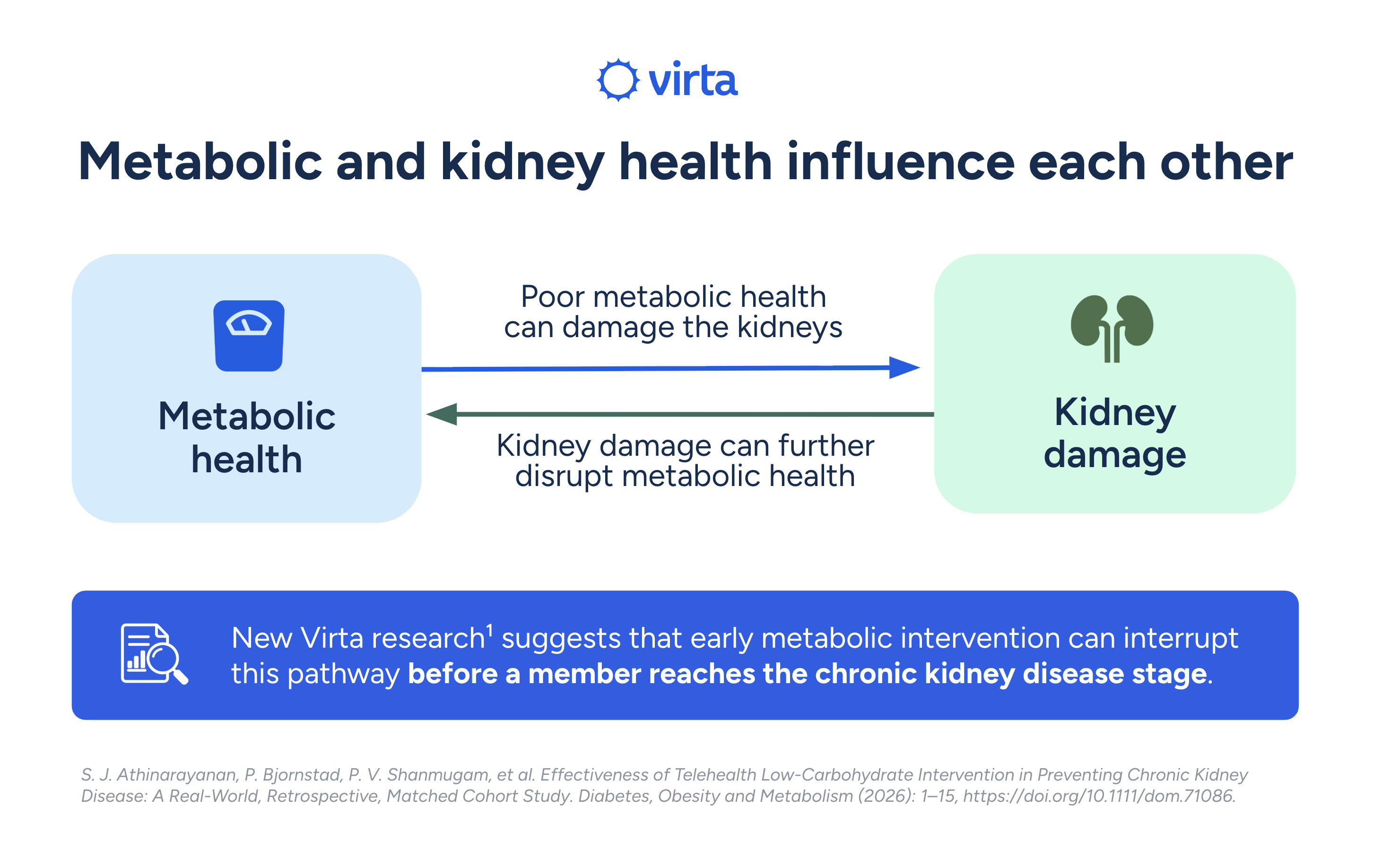
Metabolic health and kidney disease are closely related because metabolic dysfunction can damage the kidneys, while declining kidney function can, in turn, further disrupt metabolic health.
Metabolic health refers to how efficiently the body processes and manages energy from food. During metabolism, the body converts food into energy in the form of glucose, amino acids, and fatty acids. The kidneys then filter waste (e.g., chemicals, excess acids) from this process and help regulate excess blood sugar.
However, if the body struggles to process energy efficiently due to metabolic disorders like obesity, type 2 diabetes, and high blood pressure, this can directly damage the kidneys over time.
- Insulin Resistance: For example, studies3 show that when cells stop responding to insulin (known as insulin resistance, prediabetes), blood sugar rises and the kidneys are forced to overwork, causing early filtering stress and eventual damage.
- Metabolic Syndrome: Studies4 also show that a set of conditions known as “metabolic syndrome,” which includes abdominal obesity, high blood pressure, and abnormal blood lipids, overburdens kidney blood vessels and increases the risk of chronic kidney disease.
In turn, damaged kidneys further disrupt metabolic health.
Key takeaway for employers: The good news is that new Virta research1 suggests early metabolic intervention can interrupt this pathway before a member reaches the chronic kidney disease stage. I’ll explain how next.
How do metabolic interventions actually slow kidney disease progression?
Early metabolic interventions, such as personalized nutrition-based approaches, can slow kidney disease progression by reducing the kidneys' workload, controlling underlying metabolic conditions like obesity, diabetes, and high blood pressure, and decreasing systemic inflammation.
For example, nutrition strategies can reduce kidney strain by lowering excess blood sugar and addressing a root cause of kidney damage. (Remember, one way the kidneys become damaged is by struggling to filter out excess sugar.)
Virta Health’s new peer-reviewed research, published in Diabetes, Obesity and Metabolism,1 revealed that adults with type 2 diabetes or obesity participating in Virta's individualized nutrition-based treatment experienced substantially lower rates of chronic kidney disease (CKD), including a 62% lower rate of advanced kidney disease, when compared with carefully matched individuals receiving usual care. As one of the largest real-world studies of nutrition-based metabolic care, the study tracked more than 10,000 patients with follow-up extending up to 5 years.
Virta’s individualized nutrition-based treatment resulted in:
- 36% lower incidence of chronic kidney disease (CKD)
- 43% lower incidence of stage 3 or higher CKD
- 62% lower incidence of stage 4 or advanced kidney disease
- No increased risk of kidney-related safety outcomes, including kidney stones, metabolic acidosis, diabetic ketoacidosis, or gout
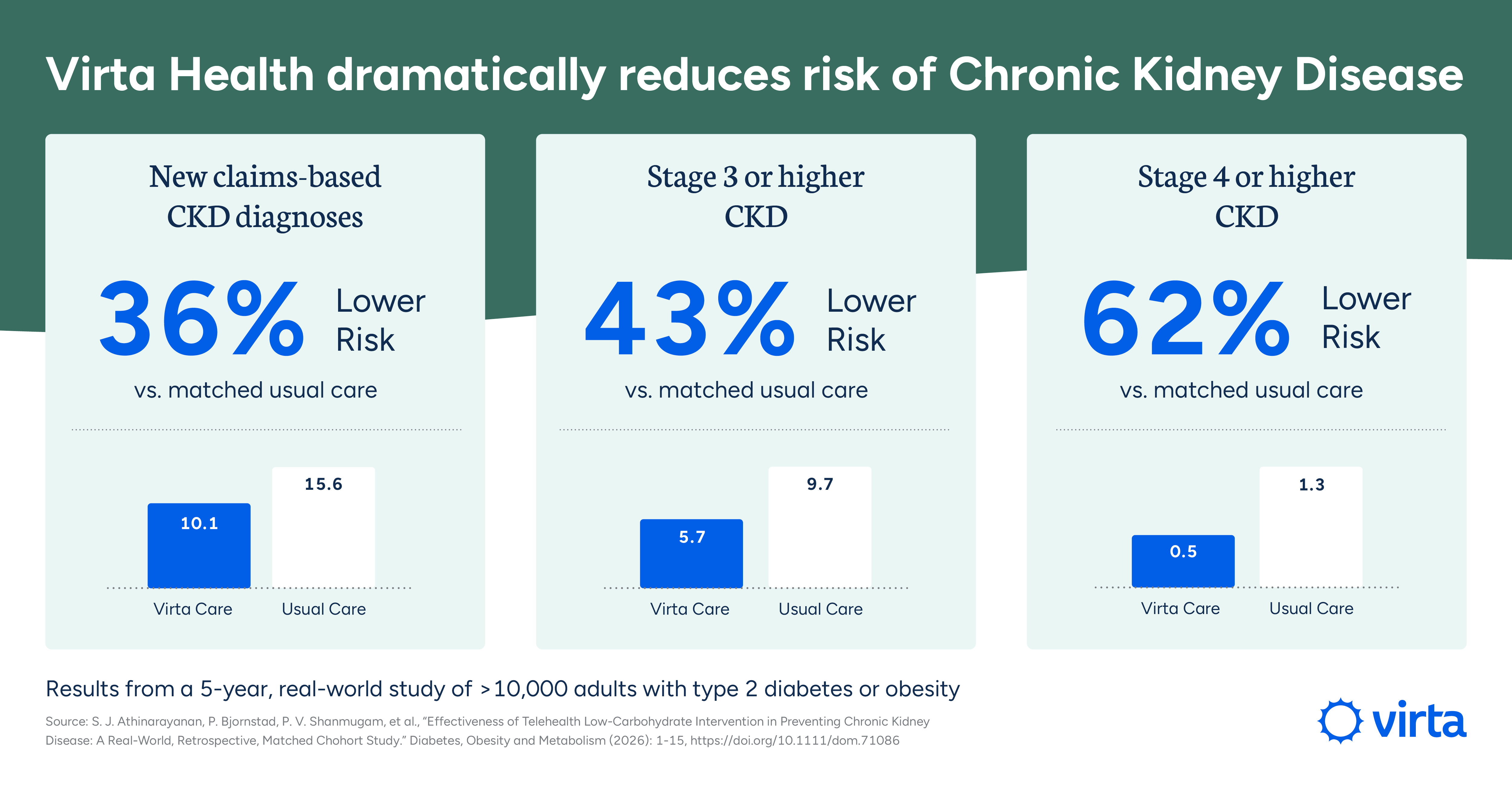
Despite widespread adoption of newer kidney-protective therapies, participants receiving Virta's individualized nutrition-based metabolic care were associated with lower rates of new chronic kidney disease (CKD) diagnoses when compared to individuals receiving usual care.
Key takeaway for employers: The findings suggest that addressing obesity and type 2 diabetes through Virta’s individualized nutrition therapy may help lower the risk of chronic kidney disease (CKD), one of the most serious long-term complications of metabolic disease.
Protein or refined carbohydrates: Which influences kidney disease progression more?
While proteins have long been assumed to drive kidney disease progression, Virta’s new findings challenge that assumption and add to the growing body of research highlighting the dangers of refined carbohydrates in accelerating kidney damage.
- Other studies also show that eating excessive amounts of refined carbohydrates (like white bread, cookies, sugary drinks) leads to excessive blood sugar and high blood pressure–both of which put additional duress on the kidney’s filtering system, causing damage over time.5
Meanwhile, a foundational study6 on the impact of restricted protein diets on kidney disease progression found a modest or limited effect, with extreme restriction adversely affecting overall morbidity and mortality.
Virta’s new research1 tracked more than 10,000 adults with type 2 diabetes or obesity participating in Virta’s personalized, nutrition-based treatment that restricts carbohydrate intake and found substantially lower rates of chronic kidney disease (CKD) with follow-up extending up to 5 years.
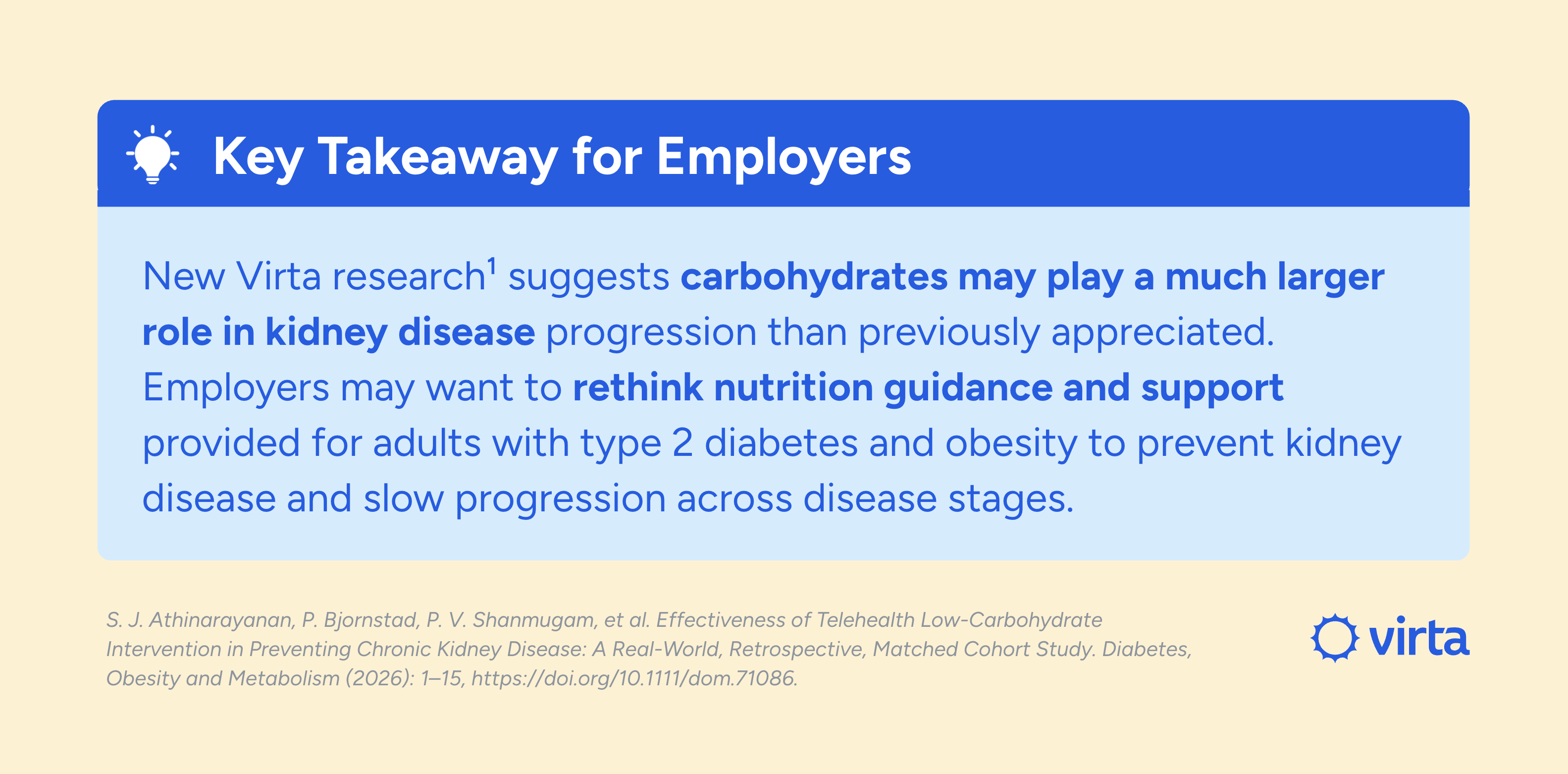
Key takeaway for employers: This new research suggests carbohydrates may play a much larger role in kidney disease progression than previously appreciated. Employers may want to rethink nutrition guidance and support provided for adults with type 2 diabetes and obesity to lower the risk of kidney disease and slow progression across disease stages.
Why employers should move from treating expensive chronic disease to reversing metabolic disease and its downstream complications
Given the high cost of treating chronic metabolic diseases like kidney disease, employers should take note of this new research: tackling metabolic disorders like obesity and type 2 diabetes at the root cause with Virta Health could change the trajectory of chronic kidney disease (CKD) and significantly reduce downstream healthcare costs for employers. Third-party reviews also suggest early intervention as a strong opportunity to improve CKD outcomes and lower the risk of disease progression.
And the cost implications aren’t just limited to kidney disease. Previous peer-reviewed studies have linked Virta Health’s individualized, nutrition-based care to improvements in chronic inflammation,7 liver disease,8 cardiovascular risk factors,9 and even pancreatic cancer treatment,10 pointing to a broader shift in medicine: treating the metabolic drivers of disease at the root cause rather than simply managing symptoms or downstream complications.
How Virta Health’s metabolic care can help employers reduce the risk of downstream complications and related costs from conditions like CKD
For your members with type 2 diabetes and obesity, the devastating and costly impacts of chronic kidney disease (CKD) should not be accepted as an inevitable consequence. Partnering with Virta Health to address metabolic drivers of the disease at the root cause offers a different possibility.
Virta Health combines individualized nutrition therapy, deep experience in GLP-1 optimization, expert clinical care, and AI-enhanced technology to deliver personalized support at scale. Together, this approach empowers members to build longer, healthier lives by losing weight, improving A1c, and improving other health outcomes that reduce the risk of downstream complications like chronic kidney disease, liver disease, cardiovascular risks, and more. Virta’s approach of tackling metabolic dysfunction at the root cause improves member health while reducing employer healthcare costs.
Related Resources
This blog is intended for informational purposes only and is not meant to be a substitute for professional medical advice, diagnosis, or treatment. Always seek the advice of your physician or other qualified health provider with any questions you may have regarding a medical condition or any advice relating to your health. View full disclaimer
Are you living with type 2 diabetes, prediabetes, or unwanted weight?

- Athinarayanan SJ, Bjornstad P, Shanmugam PV, et al. Effectiveness of telehealth low-carbohydrate intervention in preventing chronic kidney disease: a real-world, retrospective, matched cohort study. Diabetes Obes Metab. 2026;28(10):9054-9068. https://doi.org/10.1111/dom.71086
- CDC, Chronic Kidney Disease Basics, May 2024.
- Xin Xu, Xian Shao, Fan Fan Hou. Risk stratification of metabolic disorder–associated kidney disease.” Kidney International, Volume 107, Issue 6, 2025, 1002-1010, https://doi.org/10.1016/j.kint.2025.01.041
- Lin L, Tan W, Pan X, Tian E, Wu Z and Yang J. Metabolic Syndrome-Related Kidney Injury: A Review and Update.” Front. Endocrinol. (2022) 13:904001. doi: 10.3389/fendo.2022.904001
- Bamini Gopinath et al. Carbohydrate Nutrition Is Associated with the 5-Year Incidence of Chronic Kidney Disease. The Journal of Nutrition, Volume 141, Issue 3, 2011, Pages 433-439, https://doi.org/10.3945/jn.110.134304.
- Menon V, Kopple JD, Wang X, Beck GJ, Collins AJ, Kusek JW, Greene T, Levey AS, Sarnak MJ. Effect of a very low-protein diet on outcomes: long-term follow-up of the Modification of Diet in Renal Disease (MDRD) Study. Am J Kidney Dis. 2009 Feb;53(2):208-17. doi: 10.1053/j.ajkd.2008.08.009. Epub 2008 Oct 31. PMID: 18950911.
- Athinarayanan, S. J., Phinney, S. D., Adams, et al. (2026) Broad-Spectrum Effects of Carbohydrate Reduction on Inflammatory and Immune Mediators in Type 2 Diabetes,” Endocrine Research, 51(2), 100–116. https://doi.org/10.1080/07435800.2026.2659579
- Athinarayanan, S. J., Wolfberg, A. J., Shanmugam, et al. (2026). Reduced risk of liver-related events among patients receiving individualized nutrition-focused remote care in the United States. Hepatology, 84(3), 870–885. https://doi.org/10.1097/HEP.0000000000001713
- Athinarayanan, S.J., Hallberg, S.J., McKenzie, A.L. et al. Impact of a 2-year trial of nutritional ketosis on indices of cardiovascular disease risk in patients with type 2 diabetes, Cardiovasc Diabetol 19, 208 (2020). https://doi.org/10.1186/s12933-020-01178-2
- Jameson GS, Roe DJ, Borazanci E, et al. A randomized phase II trial of gemcitabine, nab-paclitaxel, cisplatin with or without a medically supervised ketogenic diet for patients with metastatic pancreatic cancer. Cancer. 2026;e70343. doi:10.1002/cncr.70343