How to Measure and Demonstrate GLP-1 Savings: Moving from Modeled Projections to Real-World Analysis



Key Takeaways
- With rising GLP-1 cost pressures, how can employers measure and demonstrate GLP-1 savings?
- To help employers reduce total cost of care, employers should expect vendors to provide real-world GLP-1 savings analysis rather than modeled projections alone.
- In a new analysis, Virta Health moves beyond modeled projections to real-world GLP-1 savings, using medical and pharmacy claims to quantify the actual cost impact of GLP-1 medication.
- Real-world claims analysis of 12,308 Virta members from 3 client employers shows Virta saved $5,600 per engaged member per year in total healthcare costs and $5.6 million for 1,000 engaged employees.1
- The difference is our approach: Virta for Weight Loss+ combines clinical nutrition with provider-led care, supported by intelligent technology, as an alternative to GLP-1s, alongside GLP-1s, or after–ultimately changing the economics of weight loss care.
As employers look for ways to control rising GLP-1 costs, the first step is to demand a higher standard from your benefit partners when calculating GLP-1 savings. While modeled projections are common (Virta uses them too), the real proof and gold standard employers deserve is actual claims-based analysis.
To help employers take control of GLP-1 costs, Virta is leading the way with a new analysis that goes beyond modeled projections to quantify real-world GLP-1 savings based on past medical and pharmacy claims.
Claims-based savings analysis is the only way to accurately quantify the total cost of weight-loss care with and without GLP-1s.
First, let me explain why that distinction matters for employers looking to drive sustainable GLP-1 cost control.
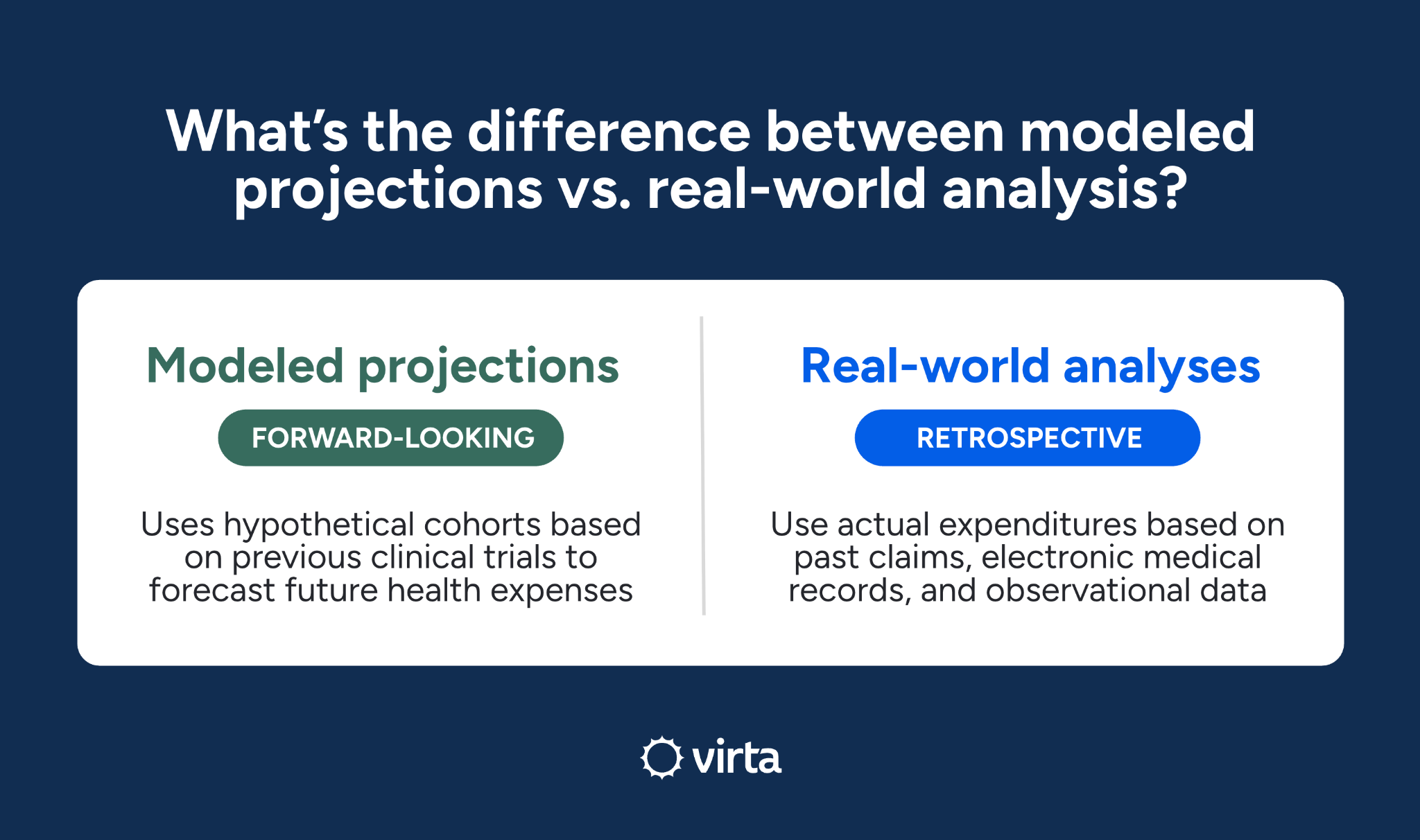
What’s the difference between modeled projections vs. real-world analysis?
- Modeled projections are forward-looking and use hypothetical cohorts based on previous clinical trials to forecast future health expenses.
- Real-world analyses are retrospective and rely on actual expenditures using past medical claims, electronic medical records, and observational data.
While modeled projections can be useful, employers should be cautious about relying on projections alone without real-world outcomes to support them.
For example, early models based on the original clinical trials conducted by pharmaceutical firms projected significant downstream healthcare savings from GLP-1s. However, in the real world, GLP-1 users demonstrated poor medication adherence and less weight loss, completely undermining initial savings projections. 2
This disconnect underscores why employers should look beyond modeled projections and demand real-world claims evidence to validate the savings they can expect from a vendor.
How does Virta’s real-world analysis demonstrate GLP-1 cost control?
In a new analysis, Virta quantifies the actual cost impact of the Virta for Weight Loss+ program.
Our GLP-1 for weight loss solution, Virta for Weight Loss+ delivers clinical nutrition support to optimize outcomes as an alternative to GLP-1s, alongside or after GLP-1s.
The Total Cost of Care analysis1 demonstrates Virta’s impact on healthcare costs by comparing Virta members with a similar group of non-Virta members. The real-world analysis uses medical and pharmacy claims to match members based on factors such as demographics, health conditions, medication use, and healthcare spending before Virta.
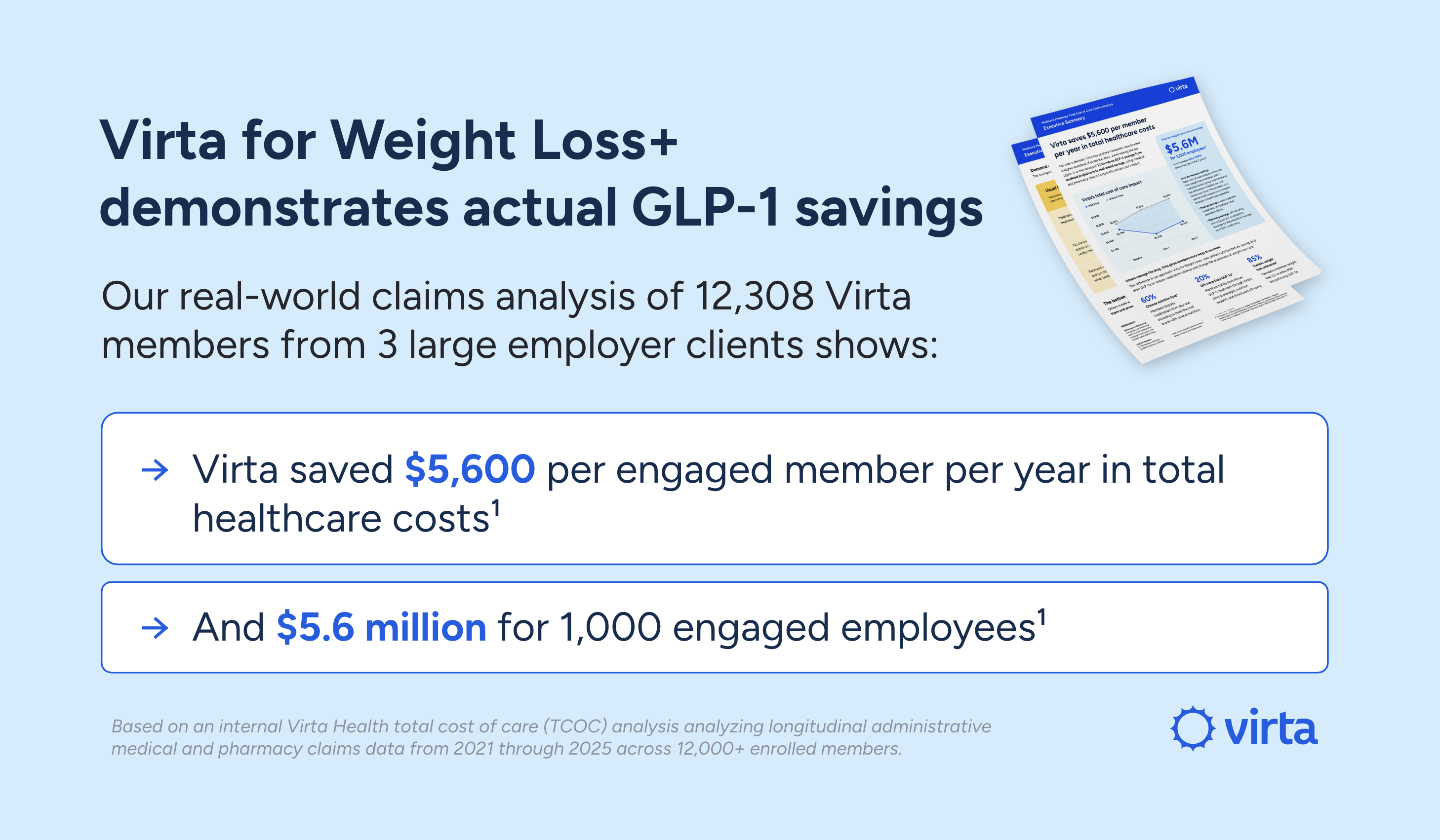
Virta for Weight Loss+ demonstrates actual GLP-1 savings
Our real-world claims analysis of 12,308 Virta members from 3 large employer clients shows:
- Virta saved $5,600 per engaged member per year in total healthcare costs1
- $5.6 million for 1,000 engaged employees1
Actual GLP-1 savings come from medical and pharmacy cost reductions, as well as avoided GLP-1 costs.
How is Virta able to drive these GLP-1 cost savings?
Virta’s fundamentally different approach to weight loss and GLP-1 care drives real savings for employers. Here’s how:
- Personalized clinical nutrition: Based on clinical needs, individual biomarkers, and member goals, we create personalized nutrition pathways that support members during, after, and without GLP-1s.
- Responsible GLP-1 prescribing and medication optimization: By requiring labs, clinical intake, and ongoing adherence tracking (like weight and injection logging to unlock refills), we ensure medication access for members who are clinically eligible, motivated, and engaged.
- Continuous remote care: Unlike traditional care, which relies on infrequent, reactive PCP visits, Virta’s prescribing providers monitor members daily. This lets us adjust dosages, manage side effects in real time, and identify early signals of weight regain.
- A proven pathway to less medication: Virta is the only solution with a physician-guided pathway to help members stop taking GLP-1s once they hit clinical health milestones, no longer want to take them, or can no longer tolerate them. Read more about Virta’s peer-reviewed study proving its approach as an effective off-ramp from GLP-1s for sustained weight loss.
How does clinical nutrition change the economics of weight loss and GLP-1 care?
Ultimately, the most effective way to lower healthcare costs is to help people improve their health and maintain those improvements over time.
Virta's clinical nutrition changes the economics of weight loss by:
- Reducing hunger cravings and helping members feel satisfied
- Personalizing their nutrition plan with foods they enjoy and changes they can stick with
- Using continuous remote biomarker monitoring to adjust their individual nutrition plan and adapt over time.
Because our personalized clinical nutrition approach is easier for members to follow and stick with in the real world, we see the following outcomes with and without GLP-1s.
With GLP-1s:
- 37% increase in weight loss when GLP-1s + the Virta Method's approach to clinical nutrition are paired together.3
Without GLP-1s:
- GLP-1-like outcomes (13% weight loss)4 with clinical nutrition alone
- And when 60% choose nutrition only, that saves the employer the GLP-1 cost altogether.5
In fact, Virta’s clinical nutrition and care team provides a viable alternative for members who prefer a medication-free option or for employers who choose not to cover GLP-1s for weight loss.
Towards real GLP-1 savings for employers
In summary, Virta’s real-world, claims-based analysis shows employers that our unique clinical nutrition approach, combined with support, drives real GLP-1 savings. When evaluating potential benefit partners, employers should demand more real-world, claims-based analysis rather than modeled projections alone to effectively drive GLP-1 savings.
To learn how Virta for Weight Loss+ can generate GLP-1 cost savings for your organization, download Virta’s new Total Cost of Care Claims Analysis.
Related Resources
Is your GLP-1 strategy built for lasting outcomes? [Checklist]
How to Turn GLP-1s into Lasting Outcomes [Guide]
The Hidden Cost of Waiting: Why Now Is The Time to Act on GLP-1s and Metabolic Health [Blog]
This blog is intended for informational purposes only and is not meant to be a substitute for professional medical advice, diagnosis, or treatment. Always seek the advice of your physician or other qualified health provider with any questions you may have regarding a medical condition or any advice relating to your health. View full disclaimer
Are you living with type 2 diabetes, prediabetes, or unwanted weight?

- Based on an internal Virta Health total cost of care (TCOC) analysis analyzing longitudinal administrative medical and pharmacy claims data from 2021 through 2025 across 12,000+ enrolled members.
- Gleason, Patrick P., Urick, Benjamin Y., et al., Real-world persistence and adherence to glucagon-like peptide-1 receptor agonists among obese commercially insured adults without diabetes. Journal of Managed Care & Specialty Pharmacy 2024 30:8, 860-867 https://doi.org/10.18553/jmcp.2024.23332
- Virta Health, 2026 Reversal Report: Metabolic Care in the GLP-1 Era.
- McKenzie AL, Athinarayanan SJ, McCue JJ, et al. Type 2 Diabetes Prevention Focused on Normalization of Glycemia: A Two-Year Pilot Study.Nutrients. 2021; 13(3):749. doi: 10.3390/nu13030749
- Virta Book of Business steerage data.